Search This Blog

9.23.2010

Down with fun : The depressing vogue for having fun at work


ONE of the many pleasures of watching “Mad Men”, a television drama about the advertising industry in the early 1960s, is examining the ways in which office life has changed over the years. One obvious change makes people feel good about themselves: they no longer treat women as second-class citizens. But the other obvious change makes them feel a bit more uneasy: they have lost the art of enjoying themselves at work.

The ad-men in those days enjoyed simple pleasures. They puffed away at their desks. They drank throughout the day. They had affairs with their colleagues. They socialised not in order to bond, but in order to get drunk.

These days many companies are obsessed with fun. Software firms in Silicon Valley have installed rock-climbing walls in their reception areas and put inflatable animals in their offices. Wal-Mart orders its cashiers to smile at all and sundry. The cult of fun has spread like some disgusting haemorrhagic disease. Acclaris, an American IT company, has a “chief fun officer”. TD Bank, the American arm of Canada’s Toronto Dominion, has a “Wow!” department that dispatches costume-clad teams to “surprise and delight” successful workers. Red Bull, a drinks firm, has installed a slide in its London office.

Fun at work is becoming a business in its own right. Madan Kataria, an Indian who styles himself the “guru of giggling”, sells “laughter yoga” to corporate clients. Fun at Work, a British company, offers you “more hilarity than you can handle”, including replacing your receptionists with “Ab Fab” lookalikes. Chiswick Park, an office development in London, brands itself with the slogan “enjoy-work”, and hosts lunchtime events such as sheep-shearing and geese-herding.

The cult of fun is deepening as well as widening. Google is the acknowledged champion: its offices are blessed with volleyball courts, bicycle paths, a yellow brick road, a model dinosaur, regular games of roller hockey and several professional masseuses. But now two other companies have challenged Google for the jester’s crown—Twitter, a microblogging service, and Zappos, an online shoe-shop.

Twitter’s website stresses how wacky the company is: workers wear cowboy hats and babble that: “Crazy things happen every day…it’s pretty ridiculous.” The company has a team of people whose job is to make workers happy: for example, by providing them with cold towels on a hot day. Zappos boasts that creating “fun and a little weirdness” is one of its core values. Tony Hsieh, the boss, shaves his head and spends 10% of his time studying what he calls the “science of happiness”. He once joked that Zappos was suing the Walt Disney Company for claiming that it was “the happiest place on earth”. The company engages in regular “random acts of kindness”: workers form a noisy conga line and single out one of their colleagues for praise. The praisee then has to wear a silly hat for a week.

This cult of fun is driven by three of the most popular management fads of the moment: empowerment, engagement and creativity. Many companies pride themselves on devolving power to front-line workers. But surveys show that only 20% of workers are “fully engaged with their job”. Even fewer are creative. Managers hope that “fun” will magically make workers more engaged and creative. But the problem is that as soon as fun becomes part of a corporate strategy it ceases to be fun and becomes its opposite—at best an empty shell and at worst a tiresome imposition.

The most unpleasant thing about the fashion for fun is that it is mixed with a large dose of coercion. Companies such as Zappos don’t merely celebrate wackiness. They more or less require it. Compulsory fun is nearly always cringe-making. Twitter calls its office a “Twoffice”. Boston Pizza encourages workers to send “golden bananas” to colleagues who are “having fun while being the best”. Behind the “fun” façade there often lurks some crude management thinking: a desire to brand the company as better than its rivals, or a plan to boost productivity through team-building. Twitter even boasts that it has “worked hard to create an environment that spawns productivity and happiness”.


If it’s fun, it needn’t be compulsory

While imposing ersatz fun on their employees, companies are battling against the real thing. Many force smokers to huddle outside like furtive criminals. Few allow their employees to drink at lunch time, let alone earlier in the day. A regiment of busybodies—from lawyers to human-resources functionaries—is waging war on office romance, particularly between people of different ranks. Hewlett-Packard, a computer-maker, recently sacked its successful chief executive, Mark Hurd, after a contractor made vague allegations—later quietly settled—of sexual harassment. (Oracle, a rival, quickly snapped up Mr Hurd.)

The merchants of fake fun have met some resistance. When Wal-Mart tried to impose alien rules on its German staff—such as compulsory smiling and a ban on affairs with co-workers—it touched off a guerrilla war that ended only when the supermarket chain announced it was pulling out of Germany in 2006. But such victories are rare. For most wage slaves forced to pretend they are having fun at work, the only relief is to poke fun at their tormentors. Popular culture provides some inspiration. “You don’t have to be mad to work here. In fact we ask you to complete a medical questionnaire to ensure that you are not,” deadpans David Brent, the risible boss in “The Office”, a satirical television series. Homer Simpson’s employer, a nuclear-power plant, has regular “funny hat days” but lax safety standards. “Mad Men” reminds people of a world they have lost—a world where bosses did not think that “fun” was a management tool and where employees could happily quaff Scotch at noon. Cheers to that.


9.18.2010

Instant vs. Delayed Gratification


Do you want it all now or are you prepared to wait? Some people have a focus on present pleasures whilst others are happy to wait for the good bits.

Instant gratification

Those who seek instant gratification have a present focus. They are less able to control impulses and are more susceptible to temptation and possibly addiction. Given a dinner, they are more likely to eat the things the like best first rather than leave them until later.

To change the mind of someone who seeks instant gratification put temptation in their path. Have what they want now to hand and offer it in exchange for future commitment.

Delayed gratification

Those who are prepared to delay gratification will put off reward to a future date, enjoying the anticipated reward in the mean time. In this way they maximize their pleasure, combining the anticipation with the pleasure of the event itself (although exaggerated anticipation can lead to disappointment).

To change the minds of someone who delays gratification, show not only the future benefits but also talk about how great it will be looking forward to the event itself.

So what?

Understand how people delay (or not) taking of pleasures, then customize the way you persuade them using rewards now or promised in the future.

If they seek instant gratification and you want future change then offer them something now to gain commitment. If they delay gratification and you want them to do something now, show them how acting now will benefit them even more in the future.

9.11.2010

Myths of longevity


There are many myths about how we are all soon going to live forever, with a number being put about by optimistic scientists. Sadly, it's not that easy. Maybe we will one day know how to truly extend our lives, but there is no clear route forward.

Our ancestors lived short lives

Myth

Our ancestors lived relatively short lives, with few people living beyond around 40 years.

Debunk

What did happen is that there was a much greater death rate in childhood. A century ago in the US, 15% of children died before their first birthday. And in adulthood, diseases and accidents did mean some died when they might have lived today. So yes, the average age has increased. But go and look at an old graveyard. Plenty of our ancestors lived their full three score years and ten -- and then some.

Medicine is extending life

Myth

Medicine now means that we are living beyond our natural lifespan.

Debunk

Medicine may help us survive illnesses, but it does not hold back the natural aging process. Accident and illness aside, we do not live any longer.

We can make insects live longer, so we're next

Myth

The ability of scientists to genetically engineer longer lifetimes for some animals means they are close to being able to significantly extend human life.

Debunk

Indeed the lives fruit flies have been engineered from 40 to 130 days, but it is a huge leap to do something similar with humans, let alone any mammals. Fruit flies are not well engineered to live very long, so they're much easier to fix.

Vitamins and drugs can significantly affect longevity

Myth

All we need to do to extend life is take the right vitamins and avoid the free radicals.

Debunk

Free radicals indeed are implicated in cell damage and the right balance of vitamins will help keep you healthy, but the natural aging process is not affected.

We already have antioxidants and enzymes that are effective at combating free radicals. Theories around using antioxidant and other drugs to slow aging is not proven. No matter what you do, there is no way of significantly eliminating free radicals.

Some of the dietary elements that have helped extend animal life, such as catalytic scavengers in works, have no effect in humans.

Experiments that increased natural defences against free radicals in fruit flies increased life by only up to 10%.

Eating less makes you live longer

Myth

Food increases the aging process, for example by adding free radicals. Therefore if you eat less you will live longer.

Debunk

Underfeeding mice has indeed led to them living longer, but their metabolism is different. In particular lab mice are very similar and are susceptible to cancer later in life. Limiting food seems to delay these cancers.

Mice and small animals also go into a form of hibernation when they do not have enough food. We do not have this facility.

Over-eating can indeed lead to heart and other conditions that reduce life. This does not mean that under-eating will extend natural life.

Under-eating diets can also lead to health problems that can shorten life.

Hormones increase longevity

Myth

Hormone production decreases as we get older. And experimental use has increased vigor. So taking hormones will extend life.

Debunk

This is non-sequitur (it does not follow).

In particular there is a focus on growth hormones after injections seemed to increase vigor. Increase vitality may increase the quality of life but there is no indication that it makes you live longer. In fact life-shortening side-effects such as cancers are now being discovered.

9.01.2010

Drink till you drop

A magic elixir is shown to promote weight loss

CONSUME more water and you will become much healthier, goes an old wives’ tale. Drink a glass of water before meals and you will eat less, goes another. Such prescriptions seem sensible, but they have little rigorous science to back them up.

Until now, that is. A team led by Brenda Davy of Virginia Tech has run the first randomised controlled trial studying the link between water consumption and weight loss. A report on the 12-week trial, published earlier this year, suggested that drinking water before meals does lead to weight loss. At a meeting of the American Chemical Society in Boston this week, Dr Davy unveiled the results of a year-long follow-up study that confirms and expands that finding.

The researchers divided 48 inactive Americans, aged 55 to 75, into two groups. Members of one were told to drink half a litre of water (a bit more than an American pint) shortly before each of three daily meals. The others were given no instructions on what to drink. Before the trial, all participants had been consuming between 1,800 and 2,200 calories a day. When it began, the women’s daily rations were slashed to 1,200 calories, while the men were allowed 1,500. After three months the group that drank water before meals had lost about 7kg (15½lb) each, while those in the thirsty group lost only 5kg.

Dr Davy confidently bats away some obvious doubts about the results. There is no selection bias, she observes, since this is a randomised trial. It is possible that the water displaced sugary drinks in the hydrated group, but this does not explain the weight loss because the calories associated with any fizzy drinks consumed by the other group had to fall within the daily limits. Moreover, the effect seems to be long-lasting. In the subsequent 12 months the participants have been allowed to eat and drink what they like. Those told to drink water during the trial have, however, stuck with the habit—apparently they like it. Strikingly, they have continued to lose weight (around 700g over the year), whereas the others have put it back on.

Why this works is obscure. But work it does. It’s cheap. It’s simple. And unlike so much dietary advice, it seems to be enjoyable too.

The Economist.

8.30.2010

When To Pay A Financial Pro


Sometimes, you can save money by doing it yourself. Here's help deciding when you need professional tax, estate or financial planning help.


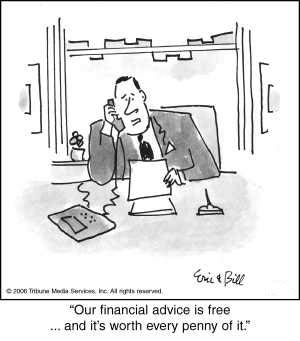
My father always told me, "You get what you pay for," and I remember distinctly that being true when my friend Nancy hired an interior decorator to help her with her living room. Nancy didn't know the first thing about decorating, except she knew the mauve couch had to go. After researching "how to" sites on the Internet, where she could try out different colors and room designs online, she realized that the more she did, the more confused she got. So she decided to hire a professional. When I went to her open house to see the unveiling of the new room, I was completely amazed at the transformation. The mustard-colored couch and deep sea blue rug matched the colors of the watercolor art work that hung on the faux finish walls, but it didn't feel forced. It fit like a favorite pair of gloves. The room felt welcoming and relaxing--sort of inviting you in. Needless to say, it was night and day from what my friend could do if she did it herself. In this case, hiring a professional was worth every penny.

In today's environment of having access to virtually unlimited financial and economic information, the challenge we face many times is truly when to do it ourselves, and when to bring in a professional. I have seen evidence of financial mistakes and oversights that people make from not having enough information, or up-to-date information, when they did it themselves. But over the years, we have seen there are also times where doing it yourself pays off--saving you money that you can use for other things. The question becomes knowing when to seek help, and when to go it alone.

Here are some tips on when to "do it yourself" and when to bring in the pros.

First, Ask Yourself These Questions
Do you have the aptitude? My friend could see right away that design and color schemes were not her cup of tea. Depending on the nature of your decision, ask yourself if this is an area in which you excel. Are you good with numbers? Are you a good researcher? Do you have a good grasp of financial concepts?

Do you have the interest? One of our planners loves taxes and said that she would love to work for a tax planning company during tax season on the weekends. I would rather crawl through broken glass. It's not that I couldn't do tax work, I just don't want to. If you don't have the interest in a certain area, you probably aren't going to be as thorough as you would if you enjoyed the subject. As a result you could miss something important.

Do you have the time? In today's economy, many people are putting even more focus on their jobs, striving to be more creative and to add value to the company they work for. Or maybe you want to focus your time on other things like your family or your hobbies. Would you get more value by hiring someone to manage your money or draft your will and estate-planning documents while you design your company's new product, write blog posts or read to your children? Consider where your time is best spent right now.

In addition to asking those questions, consider what type of advice it is that you need.

When To Pay For Tax Advice
Today's tax software programs, such as Intuit's TurboTax and H&R Block's At Home, are very comprehensive and easy to use. For basic tax returns, they are often sufficient. One of the drawbacks to using software is the absence of someone to consult with or to defend you in an audit, although some programs now offer audit relief plans.

There are two main reasons to hire a CPA or tax professional: complexity and planning. If you have enough deductions to file a Schedule A--in 2010, $5,700 for single filers; $11,400 for married filing joint--then a professional can help you maximize deductions for things such as non-reimbursed employee business expenses and charitable contributions. For many, when your return becomes more complex (e.g. declaring income in several states, owning a rental property, having a business or home office) the advice of a professional becomes crucial, and it often pays for itself.

A CPA can advise you on gray areas and red flags, helping you to decide if claiming a particular deduction is worth any potential audit that may arise. Advisors also keep up with current tax law changes and can make suggestions that save you money not only in the current year, but in future years as well. Their job is to pick up things that you might have missed. For example, a friend of mine cashed in her IRA a few years ago and she and her husband would have paid a 10% penalty for early withdrawal had they filed their taxes alone. Instead, their CPA asked if they had paid any college expenses for their son. As it turns out they did, and so my friend saved about $700 in penalty tax because the CPA was able to connect the dots.

When To Hire An Estate-Planning Attorney
For a simple will naming a trusted family member as guardian for your children, you may be safe doing it yourself. Don't forget to also put in place additional documents such as a medical power of attorney, a health care directive (living will), and a durable financial power of attorney.

If your situation calls for more advanced estate planning, such as setting up a trust or providing care for someone with special needs, then you may want to work with an experienced attorney. A good attorney will also have questions to ask that you haven't thought of, such as "Do you want the guardian of your minor children to also manage the children's assets?" The guardian you select may be the best person to raise your children, but not necessarily a good choice for handling their money. For this reason, many people name a separate person to act as the financial custodian.

An attorney can also help you set up parameters that are irrevocable once one of the trustors passes away. My colleague's mother recently passed away with a living trust in place that was set up to split her estate into two separate trusts. The first trust, a spousal trust, allowed her husband full use and access to one half of the estate (she had gotten an inheritance and wanted him to enjoy half of it). The second trust would eventually go to her two children, but her husband could enjoy any income from it during his lifetime. Well, he met a younger woman--20 years younger--and has been using trust assets to take her on weekend trips and cruises ever since. His children are now working with an attorney to reinstate the trust (which was irrevocable) and secure their half of the inheritance. No one dreamed that Dad would ever do this, but having the trust in place at least gave the children some recourse. An attorney was needed to set it up correctly in the first place, and they are glad for it. If they had done it themselves using a simple will, they would have no recourse.

When to Hire A Financial Planner
Well, to state the obvious, you want to use a planner when you have more to plan. Working with a financial planner or advisor is a long-term relationship/partnership to help you grow assets and protect assets as well as meet financial goals--most commonly retirement and college savings. There is an amazing amount of information available now for the "do it yourselfer," but a planner can be helpful not only with overall comprehensive planning, but also in some ways you may not have thought of.

Financial planners may be able to offer investment strategies that you would not have considered for yourself. For example, many retirees now are rolling over a portion of their 401(k) into a lifetime income annuity to give themselves a guaranteed lifetime income stream to complement the variable income stream they take from their 401(k). This might not be something a "do it yourselfer" would think about.

A planner can also make a difference when couples have disparate knowledge about and interest in money. In other words, if one of you is money savvy and the other is not, having a financial planner can help bridge the knowledge gap between the two of you. We've seen many times how one spouse or partner makes all the money decisions because he or she has the interest and the aptitude. In one case I recall, the husband had an aggressive risk tolerance and the wife was conservative, but she didn't participate in the money decisions. Not surprisingly, when their portfolio lost value it caused a great deal of problems between the two of them. When they went to a financial planner, it made all the difference in the world because they started making joint decisions and she started participating in their finances--not just letting him handle everything (and then blaming him for bad decisions). There is also the comfort of knowing that your spouse has an advisor to work with if something happens to you.

When to Hire A Financial Planner
Well, to state the obvious, you want to use a planner when you have more to plan. Working with a financial planner or advisor is a long-term relationship/partnership to help you grow assets and protect assets as well as meet financial goals--most commonly retirement and college savings. There is an amazing amount of information available now for the "do it yourselfer," but a planner can be helpful not only with overall comprehensive planning, but also in some ways you may not have thought of.

Financial planners may be able to offer investment strategies that you would not have considered for yourself. For example, many retirees now are rolling over a portion of their 401(k) into a lifetime income annuity to give themselves a guaranteed lifetime income stream to complement the variable income stream they take from their 401(k). This might not be something a "do it yourselfer" would think about.

A planner can also make a difference when couples have disparate knowledge about and interest in money. In other words, if one of you is money savvy and the other is not, having a financial planner can help bridge the knowledge gap between the two of you. We've seen many times how one spouse or partner makes all the money decisions because he or she has the interest and the aptitude. In one case I recall, the husband had an aggressive risk tolerance and the wife was conservative, but she didn't participate in the money decisions. Not surprisingly, when their portfolio lost value it caused a great deal of problems between the two of them. When they went to a financial planner, it made all the difference in the world because they started making joint decisions and she started participating in their finances--not just letting him handle everything (and then blaming him for bad decisions). There is also the comfort of knowing that your spouse has an advisor to work with if something happens to you.

Whether we decide to "do it ourselves" or whether we decide to work with professionals, gathering information and doing our own research along the way can only help us with our financial decisions. Being better informed, even when we decide to work with advisors, makes a difference. There may be times when it is clearly the right decision to use a professional, such as my friend deciding not to be her own interior decorator, and then there are times when it is not so clear. What I have found, however, is that Dad was right when he said, "You do get what you pay for."


Liz Davidson.

Liz Davidson is CEO of Financial Finesse, the leading provider of unbiased financial education for employers nationwide, delivered by on-staff Certified Financial Planner™ professionals.

8.23.2010

Manager's best friend

Dogs improve office productivity

OK. Here’s the plan

THERE are plenty of studies which show that dogs act as social catalysts, helping their owners forge intimate, long-term relationships with other people. But does that apply in the workplace? Christopher Honts and his colleagues at Central Michigan University in Mount Pleasant were surprised to find that there was not much research on this question, and decided to put that right. They wondered in particular if the mere presence of a canine in the office might make people collaborate more effectively. And, as they told a meeting of the International Society for Human Ethology in Madison, Wisconsin, on August 2nd, they found that it could.

To reach this conclusion, they carried out two experiments. In the first, they brought together 12 groups of four individuals and told each group to come up with a 15-second advertisement for a made-up product. Everyone was asked to contribute ideas for the ad, but ultimately the group had to decide on only one. Anyone familiar with the modern “collaborative” office environment will know that that is a challenge.

Some of the groups had a dog underfoot throughout, while the others had none. After the task, all the volunteers had to answer a questionnaire on how they felt about working with the other—human—members of the team. Mr Honts found that those who had had a dog to slobber and pounce on them ranked their team-mates more highly on measures of trust, team cohesion and intimacy than those who had not.

In the other experiment, which used 13 groups, the researchers explored how the presence of an animal altered players’ behaviour in a game known as the prisoner’s dilemma. In the version of this game played by the volunteers, all four members of each group had been “charged” with a crime. Individually, they could choose (without being able to talk to the others) either to snitch on their team-mates or to stand by them. Each individual’s decision affected the outcomes for the other three as well as for himself in a way that was explained in advance. The lightest putative sentence would be given to someone who chose to snitch while the other three did not; the heaviest penalty would be borne by a lone non-snitch. The second-best outcome came when all four decided not to snitch. And so on.

Having a dog around made volunteers 30% less likely to snitch than those who played without one. The moral, then: more dogs in offices and fewer in police stations.

Aug 12th 2010

The Economist.

Great Leaders are Strong and Courageous in Tough Times


In the process towards our goals and dreams, their will be tough times. These tough times come from situations and problems in family, business, and in our own personal lives. The secret to your leadership success in these difficult situations is for you to be strong and courageous during this process.

I am not talking about physical strength, I'm talking about mental and emotional fortitude. When a leader experiences failure, he must be strong. When a leader gets emotionally drained from hard work, he must be strong. When a leader gets disappointed, he must be strong. When a leader plans a goal, and his goal is interrupted by unexpected circumstances, he must be strong.

A great leader understands that he will experience tough times. With this awareness, he will be mentally prepared in advance to handle adversity effectively. As we develop our leadership talents, we will be able to anticipate more problems that need our attention, and will also be able to anticipate opportunities for success.

Leadership development allows the great leader to develop a quiet and peaceful strength. In other words, "great leaders are calm and confident in the most difficult situations". I understand that it is easier said then done to be calm and confident in some of these situations, but it's a "requirement" if you want to be a great leader in life and business.

While working on your goals, some of your plans may not work the way you expect. Just ask many leaders who received their pink slips this week. However, be willing to make adjustments to the plan, but keep your site on the dream and the vision that you desire for your life.

One last tip: As you make adjustments to your plan, envision the end result. This mental picture of your success is your daily inspiration.

Alexander Mobley, MBA